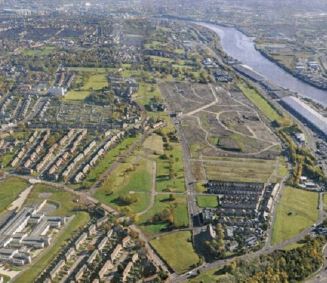
Scotswood Expo is a £250m residential development project covering an area of 42 hectares west of Newcastle upon Tyne city centre.
Project Background
Van Elle was appointed by Galliford Try to carry out the mine stabilisation project on an all-risk basis tender valued in excess of £2m, making it the largest single mine consolidation project in the Northern Coalfield to date.
Challenges
Originally a densely populated social housing area, the site was demolished and Galliford Try were appointed Main Contractor to carry out enabling works in preparation for the new build programme of works. A major part of the enabling works was the location and treatment of five known coal seams and eight recorded mineshafts across the site. The coal seams sub crop at shallow depths beneath a sloping terrain rising from the River Tyne in a northerly direction.
Van Elle Solutions
Following extensive research of historical mine records, this project involved the treatment of 5 coal seams and 11 mine shafts (three more than planned), to support a £250m residential development over 42 hectares.
Utilising a variety of track and tyre mounted rigs, a series of boreholes were drilled at 1.5 metre centres to establish the exact location of the shaft, which was then drilled to depth and grouted to consolidate. A reinforced concrete cap was then constructed over the shaft at rockhead. With full time supervision by our site manager, an experienced engineering geologist and two experienced supervisors supported by our regional office we were able to react and adjust borehole grids and locations on a daily basis, giving optimum results to the client.
Dedicated team – With a team of specialists on hand, challenges were spotted and overcome quickly.
Changing programme – The team quickly dealt with additional mine consolidation requirements.