Soil Nails

Soil Nails are a versatile and cost-effective method for stabilising slopes, embankments and landslides across a wide range of ground conditions. They are commonly used with geotextiles and mesh systems to create an integrated retaining solution for both permanent and temporary applications.

Soil nailing reinforces in-situ soils using grouted tendons, creating a reinforced soil mass that increases the stability of the slope and allows it to support greater loads or steeper faces than would otherwise be possible.

We offer a range of hollow bar and self-drilling soil nails, with diameters from 32–52 mm and load capacities from 10–550 kN. Soil nails can be formed from steel, stainless steel or GFRP (glass fibre-reinforced polymer), depending on project requirements.
Project Advantages

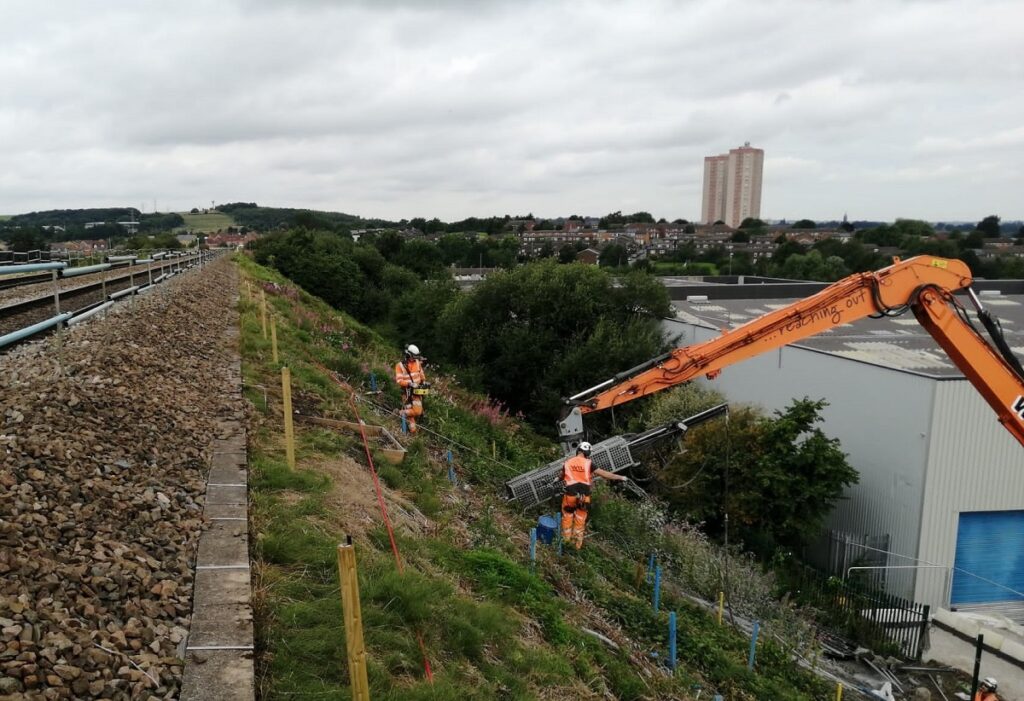
  • Can be installed using relatively small, lightweight equipment, reducing temporary works requirements and enabling access to constrained locations
  • Minimises ground disturbance, resulting in lower environmental impact compared with conventional methods
  • Can progress concurrently with excavation
  • Can be accurately tested to specified load capacities
  • A range of corrosion protection options is available

Example Applications

  • Stabilisation of failed or unstable slopes, including landslides
  • Regrading of natural slopes to achieve steeper angles
  • Strengthening of slopes in preparation for changes in loading conditions
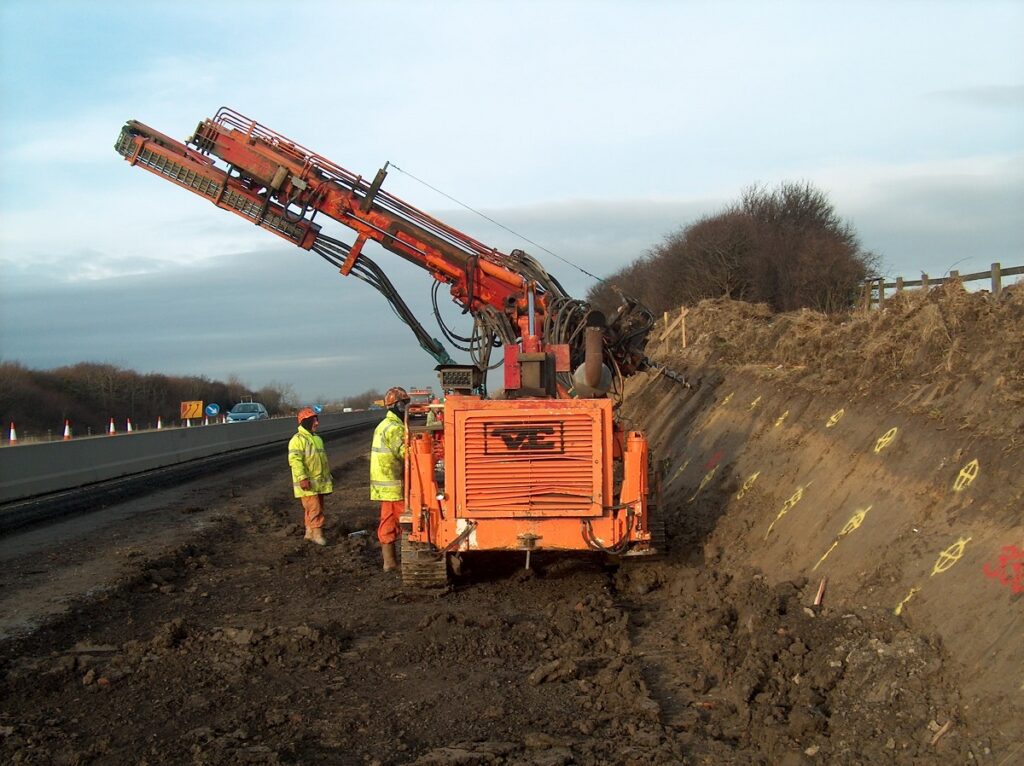
Soil nail installation by Van Elle

Understanding Soil Nails

Soil nails are installed into the slope and grouted to transfer loads into the surrounding ground. Installation equipment can be selected to suit site access and working area constraints.

Soil nails can be installed by drilling into the slope with a grout flush, or by inserting tendons into pre-drilled holes and grouting them into place.

Hollow bar, self-drilling soil nails are advanced into the ground while grout is pumped through the centre of the bar, forming a grout body around the nail to transfer loads into the surrounding ground.

In harder ground conditions, holes may be pre-drilled before the soil nail is inserted and grouted into place. Spacers can be used to maintain the central position of the nail within the borehole.

A steel bearing plate is fixed to the exposed end of each nail, with mesh and/or matting applied to the slope face to provide surface retention and help control erosion.

Soil nails are best suited to cohesive soils but can also be effective in weak rock.

They are particularly suitable for restricted-access sites, where installation equipment can be selected to suit site constraints and may be smaller than that required for conventional retaining systems.