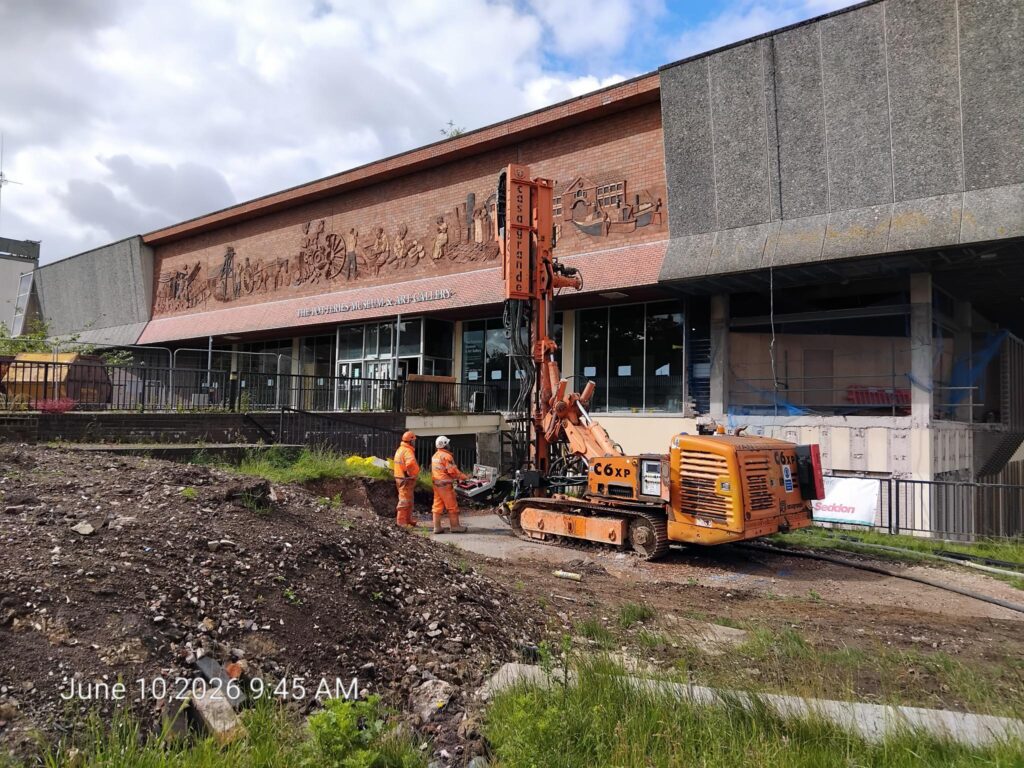
Van Elle was appointed by Seddon Construction to undertake shallow mine workings consolidation works at the Potteries Museum and Art Gallery. The project formed part of enabling works for a new museum entrance, with ground treatment required to stabilise historical mine workings and create suitable ground conditions for subsequent piling operations.
Project Background
- Appointed by Seddon Construction.
- The scope of works involved probe drilling and mine consolidation within a restricted area adjacent to the existing building. Using industry-standard bulk infilling and grouting techniques, the team drilled into the former workings and injected grout to fill voids and improve ground stability.
Challenges
The project was undertaken within a highly constrained working environment, presenting several logistical and technical challenges. Access to the treatment area was limited due to the proximity of the existing museum building, requiring careful planning of drilling operations and equipment positioning.
The team also had to work around numerous existing underground services, including high-voltage electrical cables and major fibre optic infrastructure.
These constraints required a cautious and controlled approach to ensure the safety of personnel, protection of critical services and successful delivery of the works.
Van Elle Solutions
To address the restricted access conditions, the team carried out detailed planning and utilised drilling methods that allowed the required treatment works to be completed within the confined working area. Probe drilling was undertaken around the perimeter of the building to accurately identify and assess the extent of the former mine workings before consolidation activities commenced.
The mine workings were then stabilised through a programme of bulk infilling and grout injection. Drilling was completed on a structured grid pattern to a depth of up to 20 metres below ground level, ensuring comprehensive treatment of the affected area.
The sucessful completion of the mine consolidation works provided a stable foundation for the next phase of construction, supporting the development of the museum’s new entrance facilities.