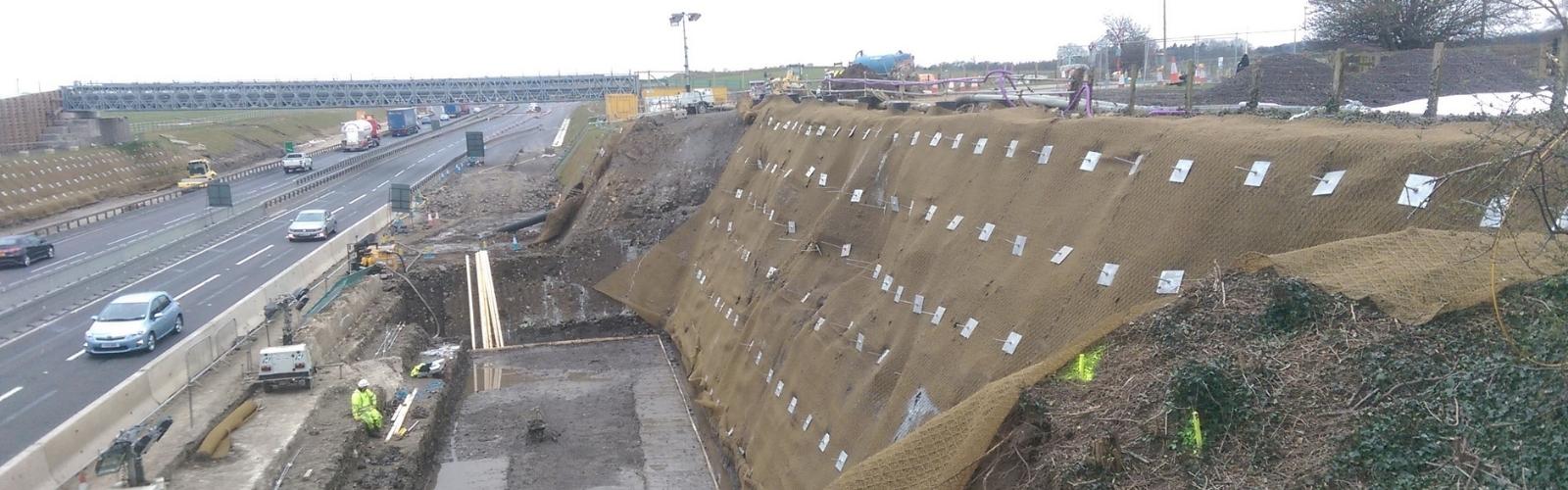
Rock Bolts and Netting

Rock bolts are commonly used to stabilise weathered or fractured rock faces, cuttings, tunnels and bridge structures where there is a risk of rockfall or movement.

They are often used with wire fall-arrest netting and shotcrete to provide a robust and cost-effective slope stabilisation solution

Rock bolts typically consist of a steel tendon, although alternative materials such as GFRP (glass fibre-reinforced polymer) may also be used.

They can provide localised anchorage for individual unstable features or be installed across an entire rock face to improve overall stability.

Project Advantages

  • Straightforward installation process
  • Cost-effective solution
  • High tensile strength achieved almost immediately
  • Netting is flexible to follow existing slopes and rock profiles
  • Does not inhibit vegetation regeneration

Example Applications

  • Improve the stability and structural integrity of a rock mass
  • Fix rock netting and stabilise cliffs or slopes
  • Structural repairs – to retain walls, wing walls, and tunnels

Understanding Rock Bolts and Netting

Rock bolts are typically installed into pre-drilled boreholes in the rock, although self-drilling systems can also be used.

The bolts are fixed in place using cementitious grout or resin and, where required, tensioned to secure loose sections of rock.

Rock bolts are generally installed in a grid pattern, transferring loads from unstable or fractured sections of rock into stronger, load-bearing rock behind.

This effectively ‘knits’ the rock mass together, helping to prevent movement and improve overall face stability.

Surface retention systems, including wire fall-arrest netting and shotcrete, can be installed alongside rock bolts to contain loose rock and protect the face.

For steeper or weaker rock faces, shotcrete can provide a continuous surface retention system and form part of a cost-effective stabilisation solution.