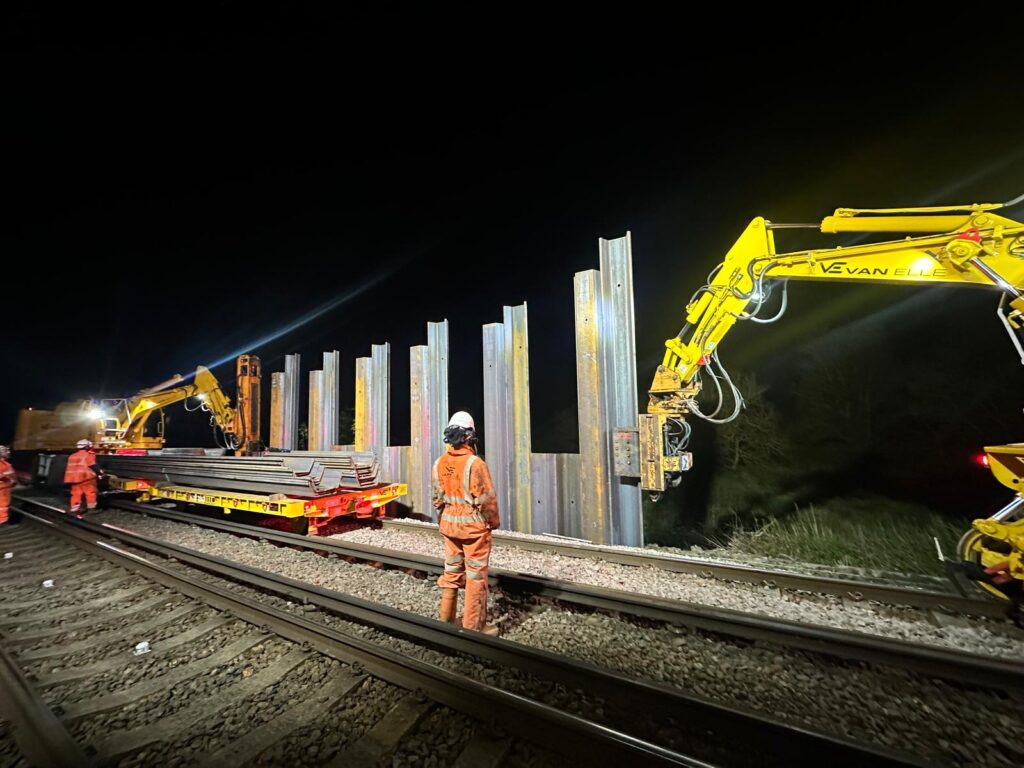
Van Elle’s Rail team were appointed to conduct Track Stabilisation works and construct the CESS Walkway. These improvements aim to enhance the overall safety, accessibility, and reliability of the railway infrastructure.
Project Background
- Appointed by Volker Fitzpatrick Rail.
- Our scope included the removal of the existing CESS retention system and through route, followed by the reinstatement to ensure proper alignment and functionality.
- Safety enhancements were implemented through the installation of a Key-Clamp handrail and the construction of a CESS walkway to facilitate safe pedestrian movement along the track. Additionally, track rectification works were carried out, including ballast shoulder reinstatement to enhance track stability and structural integrity.
- These improvements aim to enhance the overall safety, accessibility, and reliability of the railway infrastructure.
Key Figures
- 72No. 11m Sheets
- 62No. 3m Sheets
- 92No. 6m Sheets
- 94No. 2m Sheets
Challenges
The project faced significant challenges, primarily due to site access. One of the key challenges was the Plant & Material Storage Area, as Teston Country Park car park was designated for storage, requiring road closure liaison for all deliveries. The storage area was located around 250 metres away from the level crossing (On Tracking Location), necessitating the use of transport wagons.
Hardened ground conditions around the culvert required pre-auguring at all 11m sheet pile clutch locations along a 44-metre stretch of embankment to accommodate the piling process. The sheet piling works also presented a logistical challenge, as installation had to be completed within a 100-hour blockade.
Van Elle Solutions
All deliveries from the storage area to the site location required careful planning and coordination from teams that met restrictions within the road closure schedule. The team were required to meticulously plan the use of transport wagons to move all sheet piles and other materials efficiently due to the location of site.
Sheet Piling works also required planning and execution over nine consecutive 12-hour shifts, including the mobilisation of all plant and materials from the storage area to the site.